Assembly
Neodymium Cup Magnet
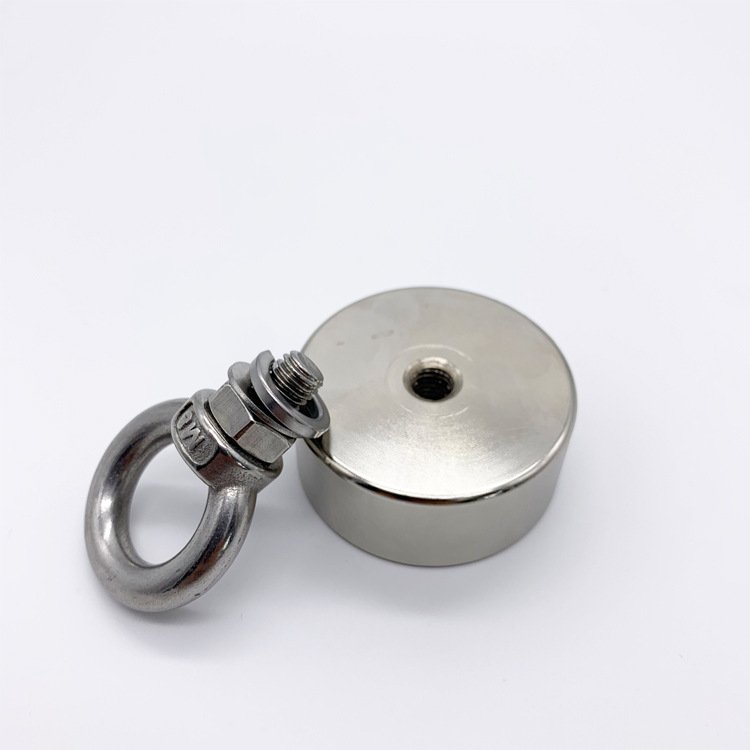
Neodymium cup magnets are shallow pot assemblies for light holding and mounting duty. YUECI KEJI supplies cup assemblies with countersunk bore or plain base in a range of diameters.
Specifications
| Magnet | Available grades, temperature ratings and coatings are confirmed against your drawing and operating conditions at quotation. |
|---|---|
| Housing | Steel cup, zinc-plated or Ni-Cu-Ni |
| Shape | Cup / shallow pot assembly |
| Coating | Zinc plating / Ni-Cu-Ni / epoxy on request |
| Tolerance | Dimensional tolerances are confirmed against the approved drawing and depend on part size, geometry and finishing process. Please identify critical dimensions when requesting a quotation. |
| Magnetization | Axial (single pole face) |
| Applications | Light holding and mounting, Craft and display, Sensor targets |
| Lead time | Production lead time and shipping transit time are quoted separately. The confirmed schedule depends on the approved drawing, quantity, documentation requirements, destination and shipping method. |
| MOQ | Quoted per inquiry |
| Export control | Export classification is confirmed per shipment against the product composition and destination. |
What is a neodymium cup magnet
A neodymium cup magnet is a shallow pot assembly: a sintered NdFeB disc seated in a thin steel cup. Because the cup is shallow, most of the assembly is magnet, and the force-to-size ratio is high for its diameter — which is what makes the cup format the default for light holding and mounting duty.
At YUECI KEJI cup assemblies are supplied with a countersunk bore or a plain base, in a range of diameters, zinc or nickel plated.
How the gaussmeter works
Flux leaves the magnet’s working face, spreads through the shallow cup and concentrates at its rim, then returns through the workpiece. The steel return path is what makes the assembly pull harder than the bare disc.
The shallow cup is the trade: less steel means less flux concentration than a deep pot at large diameters, but a better force-to-size ratio at small ones. That is why cups dominate light mounting and pots dominate heavy holding.
Magnet, material and finish
The magnet is sintered NdFeB in the commercial grade range, sized to the cup and the holding target. The cup is steel, zinc-plated or nickel-plated, with epoxy coating available for corrosive or handled environments.
Because the magnet is enclosed, the assembly tolerates workshop and outdoor conditions that would corrode a bare disc.
Typical applications
Cup assemblies end up wherever light holding has to be mounted and forgotten: craft and display work, signage, sensor targets and fixtures, and light mounting assemblies.
Handling, storage and shipping
Cup assemblies ship in padded packing with the working faces protected. Cups in bulk attract each other, so cartons are spaced or separated.
Custom sizing, prototyping and order minimums
Every assembly is built to your drawing or reproduced from your sample: magnet grade, cup dimensions, thread or fastener, finish and packing. Samples come first, then volume; repeat orders are faster because the tooling and the pull-force routine already exist.
Grade, temperature and coating — how this part is specified
A complete assembly specification names the magnet grade, the cup or housing material and dimensions, the fastener or thread, the finish, the required pull force and the destination. Pull force is quoted against a defined test block, because the number depends on the steel as much as on the magnet.
Designing the magnetic circuit and working on the line
A cup assembly is specified by the holding target and the diameter available. If the hold is short, the next diameter up recovers more than a grade change because the pole area grows with the square of the diameter.
When to choose a different shape
A cup is the default for light mounting. Move to a deeper pot when the diameter is large and the hold is heavy, to a bare disc when reach matters more than force, and to a clamp when the load has to be positioned.
Where this material is typically used
Cup assemblies end up in craft, display and light mounting work — the high-volume end of the assembly market.
Why buyers choose it
- Shallow cup: most of the assembly is magnet, so the force-to-size ratio is high.
- The cup shields and protects the magnet from impact and corrosion.
- Countersunk bore or plain base — the fixing is specified with the part.
- Single pole face: the working face is the only strong pole.
Applications
Light holding and mounting
Craft, display and signage
Sensor targets and fixtures
Buyer Questions
Neodymium Cup Magnet FAQs
What is the difference between a cup and a pot magnet?
Depth. A cup is shallow, so most of the assembly is magnet and the force-to-size ratio is higher for a given diameter; a pot is deeper, which adds force on larger diameters.
What fixings are available?
Countersunk bore for a flush screw, or a plain base for bonding. The fixing is specified with the part.
Are cup magnets export Export documentation and licensing requirements are confirmed per shipment.?
Export classification is confirmed per shipment against the product composition and destination.
Request a quote for Neodymium Cup Magnet
You may also like