Ferrite
Ferrite Speaker Magnet
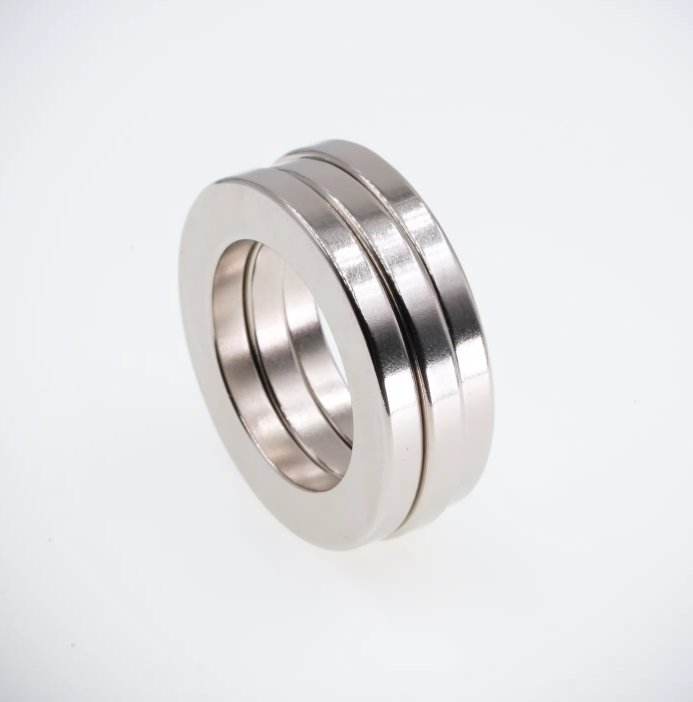
Ferrite speaker magnets are the ceramic rings that sit behind every moving-coil driver. YUECI KEJI presses and magnetizes ferrite speaker rings to your OD, ID and thickness.
Applications
Loudspeaker drivers
Microphones and earpieces
Actuators and motors
Why buyers choose it
- Ferrite is the lowest-cost permanent magnet family per unit.
- Intrinsic corrosion resistance — no plating needed in humid or outdoor duty.
- Dimensional tolerances are confirmed against the approved drawing and depend on part size, geometry and finishing process. Please identify critical dimensions when requesting a quotation.
- Operating temperature well above the standard NdFeB range.
Specifications
| Material | Hard ferrite (ceramic) |
|---|---|
| Shape | Ring (speaker) |
| Coating | As-pressed / painted / epoxy on request |
| Tolerance | Dimensional tolerances are confirmed against the approved drawing and depend on part size, geometry and finishing process. Please identify critical dimensions when requesting a quotation. |
| Magnetization | Axial through the faces |
| Applications | Loudspeaker drivers, Microphones, Actuators |
| Lead time | Production lead time and shipping transit time are quoted separately. The confirmed schedule depends on the approved drawing, quantity, documentation requirements, destination and shipping method. |
| MOQ | Quoted per inquiry |
| Export control | Export classification is confirmed per shipment against the product composition and destination. |
What is a ferrite speaker magnet
Ferrite speaker magnets are ceramic rings that sit behind the voice coil of a moving-coil driver, supplying the field the coil works against. The ring format — a through-bore for the pole piece and a flat annulus for the top plate — is the geometry the motor structure is built around.
At YUECI KEJI ferrite speaker rings are pressed, sintered and ground to your OD, ID and thickness, then magnetized axially through the faces. No plating is needed.
Ferrite material properties
Hard ferrite — also called ceramic magnet — is made from strontium or barium ferrite powder pressed into shape and sintered. It is the lowest-cost permanent magnet family, it resists corrosion naturally with no plating, and it tolerates temperatures well above the NdFeB range.
Ferrite is brittle: hard and dimensionally stable, but it chips or cracks if dropped or clamped with sharp force, so it suits assemblies where impact is unlikely. Its corrosion resistance is intrinsic — there is no exposed iron at the surface — which is why it is the default for wet, outdoor and cost-first duty.
Against NdFeB the trade is explicit: ferrite delivers roughly a quarter of the energy per unit volume, at a fraction of the material cost and with far better temperature and corrosion behaviour. Where force density is the constraint, NdFeB wins; where price, temperature and weather win, ferrite wins.
Shape, dimensional tolerance and magnetization
Dimensional tolerances are confirmed against the approved drawing and depend on part size, geometry and finishing process. Please identify critical dimensions when requesting a quotation.
Surface treatment
Ferrite needs no plating. Rings are supplied as-pressed, painted or epoxy-coated for appearance or mechanical protection, and bonded for assemblies glued to the top plate.
Typical applications
Ferrite speaker rings end up in loudspeaker drivers, microphones and earpieces, and in actuators and motors that use the same motor structure at a larger scale.
Handling, storage and shipping
Ferrite is brittle, so rings ship in padded, separated packing. There is no plating to corrode, so dry storage is enough.
Custom sizing, prototyping and order minimums
Every OD, ID, thickness and magnetization direction is built to your drawing or reproduced from your sample. Volume programs run from existing tooling where the geometry allows, which keeps the piece price low.
Grade, temperature and coating — how this part is specified
A complete specification names the material grade, the OD, ID and thickness, the magnetization direction and the quantity. The exact grade window is confirmed on request.
Designing the magnetic circuit and working on the line
A speaker ring is specified by the gap it has to fill and the flux that gap needs. Because ferrite energy per unit volume is roughly a quarter of NdFeB, a stronger driver usually means a thicker ring rather than a different material — which is why ferrite remains the default at every price point that allows it.
When to choose a different shape
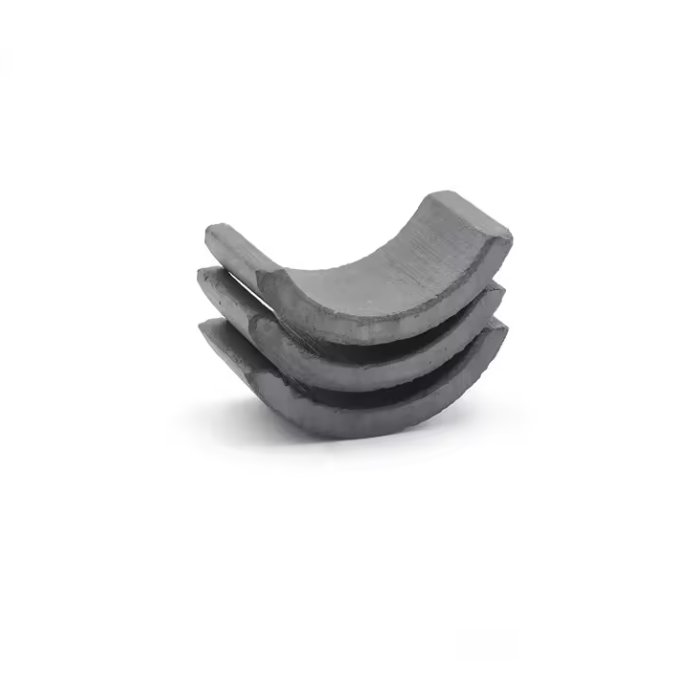
A ring is the default for speaker duty. Move to NdFeB when force density is the constraint, to a segment when the pole must curve around a rotor, and to a disc when no bore is needed.
Where this material is typically used
Ferrite speaker rings end up in every moving-coil driver that is not explicitly a high-force design — the high-volume audio market.
Buyer Questions
Ferrite Speaker Magnet FAQs
Why is ferrite still standard in speakers?
Cost, temperature behaviour and corrosion resistance. Ferrite delivers enough flux for a motor structure at a fraction of NdFeB cost, and the bare ceramic survives humid cabinets.
Can speaker rings be supplied with a bonded face?
Yes. Bonded versions are supplied for assemblies glued to the top plate, and uncoated rings for assemblies held mechanically.
Are ferrite speaker magnets export Export documentation and licensing requirements are confirmed per shipment.?
Export classification is confirmed per shipment against the product composition and destination.
Request a quote for Ferrite Speaker Magnet
You may also like