Ferrite
Ferrite Tile Magnet
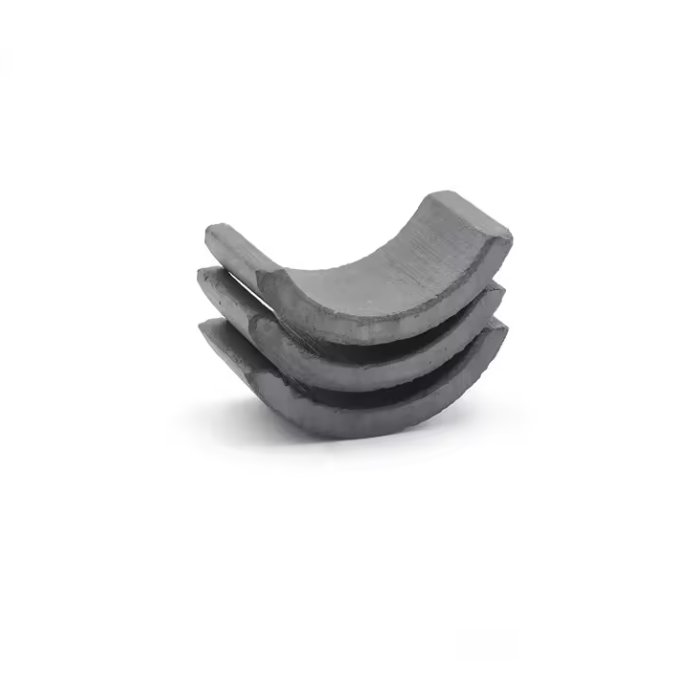
Ferrite tile magnets are curved ceramic slabs that nest into pole rings for motors, couplings and separators. YUECI KEJI presses and magnetizes ferrite tiles to drawing with no plating needed.
Applications
Motor and pump pole rings
Magnetic separators and grill arrays
Couplings and curved assemblies
Why buyers choose it
- Ferrite is the lowest-cost permanent magnet family per unit.
- Intrinsic corrosion resistance — no plating needed for outdoor or wet duty.
- Dimensional tolerances are confirmed against the approved drawing and depend on part size, geometry and finishing process. Please identify critical dimensions when requesting a quotation.
- Operating temperature well above the standard NdFeB range.
Specifications
| Material | Hard ferrite (ceramic) |
|---|---|
| Shape | Tile / curved slab |
| Coating | As-pressed / painted / epoxy on request |
| Tolerance | Dimensional tolerances are confirmed against the approved drawing and depend on part size, geometry and finishing process. Please identify critical dimensions when requesting a quotation. |
| Magnetization | Axial through the thickness / radial on request |
| Applications | Motor pole rings, Separators, Couplings |
| Lead time | Production lead time and shipping transit time are quoted separately. The confirmed schedule depends on the approved drawing, quantity, documentation requirements, destination and shipping method. |
| MOQ | Quoted per inquiry |
| Export control | Export classification is confirmed per shipment against the product composition and destination. |
What a ferrite tile actually is
A ferrite tile is a curved ceramic slab with a flat back, not a wedge: it is glued or bonded onto a housing wall so its curved face forms part of a pole ring. The tile is the ferrite equivalent of an NdFeB arc — same curved pole work, in the material that costs least and survives most.
At YUECI KEJI tiles are pressed, sintered and ground to your radii and angle, then magnetised to drawing. No plating is needed, and matched sets are inspected together so the ring closes correctly once bonded into the housing.
Why tile geometry drives the build
Dimensional tolerances are confirmed against the approved drawing and depend on part size, geometry and finishing process. Please identify critical dimensions when requesting a quotation.
Material behaviour you design around
Hard ferrite is a strontium or barium ceramic — the lowest-cost permanent-magnet family, corrosion-resistant with no plating, and happy well above the NdFeB temperature ceiling. It is brittle, so a tile cracks if dropped or bent; it suits bonded assemblies where the backing takes the load. Against NdFeB the trade is explicit: roughly a quarter of the energy per unit volume, at a fraction of the cost and with far better heat and weather behaviour.
Tile-specific applications
Tiles are the bonded-pole workhorse: pump and compressor pole rings, large-diameter separator arrays, magnetic holding and lifting faces, and coupling rings where the field is built into a bonded assembly rather than a free ring. When the carrier is steel or plastic and the pole face must be flush, tiles beat loose segments.
Handling, bonding and shipping tiles
Because the ceramic is brittle, tiles ship in padded, separated packing with the faces protected. There is no plating to corrode, so dry storage is enough; matched sets are kept together and labelled by ring for bonding.
Custom radii, angles and order minimums
Every radius, angle, thickness and magnetisation direction is built to your drawing or reproduced from a sample. Matched sets are ground and magnetised together so the pole pattern closes; repeat orders are faster because the tooling exists.
Specifying a tile order
A complete specification names the material grade, the radii, the angle, the thickness, the magnetisation direction and the quantity. For a tile the bond face and flatness are as important as the magnet grade, and the exact grade window is confirmed on request.
Designing the bonded-pole circuit
A tile circuit is designed around the bonded ring, not the grade: because the energy per unit volume is roughly a quarter of NdFeB, the cheapest fix for a missed flux target is usually a thicker tile, a tighter air gap, or more poles — not a material change. Size the bond area for shear and thermal load.
When a tile is the wrong shape
A tile is the default for curved ferrite pole work that is bonded into a carrier. Move to a full ring when the annulus is continuous, to a block when the pole face is flat, and to NdFeB when force density beats price.
Where tiles are typically used
They end up in pumps, separators and couplings — the high-volume, cost-first curved-pole jobs where the tile is glued into a steel or plastic housing.
Buyer Questions
Ferrite Tile Magnet FAQs
When should I choose ferrite over neodymium for a tile?
When price, temperature or weather resistance matters more than force density. Ferrite tiles cost a fraction of NdFeB and survive conditions bare NdFeB cannot.
Do ferrite tiles need coating?
No. The ceramic body resists corrosion intrinsically; painting or epoxy is optional for appearance or extra mechanical protection.
Are ferrite tiles export Export documentation and licensing requirements are confirmed per shipment.?
Export classification is confirmed per shipment against the product composition and destination.
Request a quote for Ferrite Tile Magnet
You may also like