Alnico
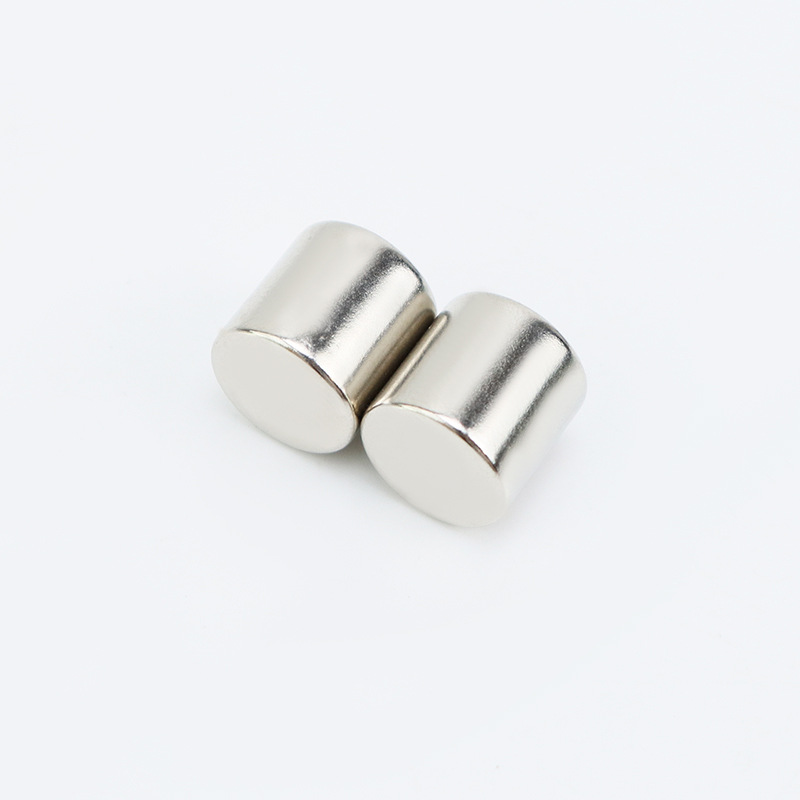
Alnico Disc Magnet
Alnico disc magnets are aluminium-nickel-cobalt discs prized for thermal stability from cryogenic up to several hundred degrees Celsius. YUECI KEJI casts or sinters alnico discs to drawing with low drift for sensors and instruments.
Applications
Sensors and meters
Instrument magnets
Thermally stable flux targets
Meter magnets and instrument motors where drift over temperature cannot be tolerated.
Flux-target assemblies and loudspeaker motors needing a consistent air gap.
Why buyers choose it
- Alnico's very low temperature coefficient keeps field stable over a wide range.
- Cast or sintered, so disc shapes are practical.
- Less brittle than ferrite and more machinable after casting.
- Supplied unmagnetized or magnetized, with keeper advice on request.
- Two flat pole faces seat flush against yokes, armatures and sensor housings.
- Axial-through-face magnetization gives a clean north-south stack for couplings and rotors.
- Counterbores, steps or odd diameters are practical because alnico is cast or sintered, not pressed from powder.
Specifications
| Grade | Alnico (Al-Ni-Co) |
|---|---|
| Shape | Disc |
| Coating | Bare / Epoxy / Ni-Cu-Ni (custom on request) |
| Tolerance | Dimensional tolerances are confirmed against the approved drawing and depend on part size, geometry and finishing process. Please identify critical dimensions when requesting a quotation. |
| Magnetization | Axial through the faces |
| Applications | Sensors and meters, Instrument magnets, Thermal-stable targets |
| Lead time | Production lead time and shipping transit time are quoted separately. The confirmed schedule depends on the approved drawing, quantity, documentation requirements, destination and shipping method. |
| MOQ | Quoted per inquiry |
| Export control | Export classification is confirmed per shipment against the product composition and destination. |
The alnico disc as a flush pole
An alnico disc is a flat round aluminium-nickel-cobalt part whose poles sit on its two faces. You reach for it when the field has to cross a round opening and the part must sit flush or stack in an assembly. The disc is the gauge-and-meter shape of the catalogue.
At YUECI KEJI discs are cast or sintered to your diameter and thickness, magnetised through the faces, then inspected. Diameter, thickness, grade and any machining are built to drawing.
How the through-face field shapes the part
Because the poles are on the faces, the useful field crosses the thickness, so a disc is the natural choice for a short, stackable two-pole path. We hold commercial tolerances on diameter and thickness, with tighter bands quoted per drawing. Alnico is brittle like a soft tool steel, so discs are machined to final size before magnetisation, never after.
Heat is where alnico wins
For a disc, the through-thickness field is the thing to protect: alnico holds flux where NdFeB and ferrite fade, and it takes mechanical heat that wrecks other magnets. The price is low coercivity — a field opposing the face-to-face magnetisation can partly demagnetise it, so disc layouts keep a safe point with good return iron across the stack. Indoor air needs no plating.
Where discs actually go
Discs are the gauge, meter and sensor staple: analogue meter movements, magnetic gauges and indicators, reed-switch biasing, and flush-mounted holding faces. When you need a stable axial field through a round opening that stacks flat, the disc is the default.
Packing and storage
Discs ship in padded packing with the faces protected; a disc stacks flush, but keep it clear of strong axial fields that could knock it down. Indoor storage needs no plating.
Custom diameters, thicknesses and minimums
Every diameter, thickness, grade and finish is built to your drawing or matched from a sample. Discs are machined before magnetisation; prototype quantities are supported.
Specifying a disc order
Name the grade, the diameter and thickness, the through-face magnetisation, any machining and the quantity. The exact temperature class is confirmed on request.
Designing the disc circuit
A disc is a face-to-face two-pole path: route return iron across the stack at low reluctance, and shield the faces from any field opposing the through-thickness magnetisation. Heat stability plus a flush face is the disc's real advantage, so it is the pick when temperature rules out NdFeB and ferrite.
When a disc is the wrong shape
A disc fits a flush axial field through a round face. Move to a bar when the field must run end to end, to a ring when you need a centred bore, and to NdFeB when cold pull beats temperature.
Where discs are typically used
They end up in meters, gauges, reed-switch biasing and flush holding faces — the stable, stackable, heat-proof axial-field work other magnets cannot do.
Buyer Questions
Alnico Disc Magnet FAQs
Why choose alnico over neodymium for a disc?
Alnico's field stays predictable across a much wider temperature range than neodymium, which is why it is specified for sensors and instruments where drift cannot be tolerated. Neodymium wins on raw strength at room temperature.
Does alnico need a keeper in storage?
Because alnico has low coercivity it is easier to demagnetize if mishandled, so discs are often stored with a keeper. We can advise on storage and supply magnetized or unmagnetized parts.
Are alnico discs export Export documentation and licensing requirements are confirmed per shipment.?
Export classification is confirmed per shipment against the product composition and destination.
Request a quote for Alnico
You may also like