
Measuring
Digital Gaussmeter
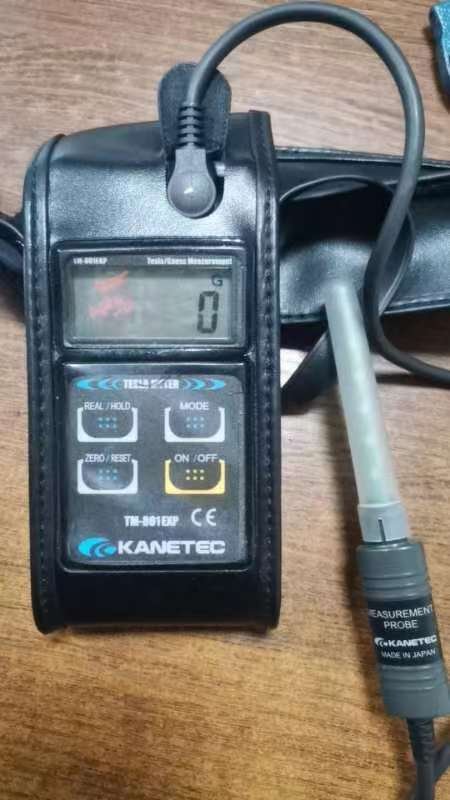
Digital gaussmeters are handheld tesla meters for checking surface field on magnets and assemblies. YUECI KEJI supplies handheld digital gaussmeters with axial and transverse probes for incoming inspection and line checks.
Applications
Incoming inspection of magnets and assemblies
Line checks and process control
Field mapping and fixture verification
Why buyers choose it
- Handheld and battery powered — usable at the bench and on the line.
- Axial probe reads surface field on magnet faces and assembly poles.
- Real-time reading with peak hold and zero/reset for repeatable checks.
- mT and Gs selectable, so readings match the drawing units.
Specifications
| Type | Handheld digital gaussmeter (tesla meter) |
|---|---|
| Probe | Axial measurement probe, Hall-effect |
| Display | Backlit LCD, real-time reading |
| Units | mT and Gs selectable |
| Functions | Real-time reading, peak hold, zero/reset |
| Applications | Incoming inspection, Line checks, Field mapping |
| Power | Battery powered |
| Lead time | Production lead time and shipping transit time are quoted separately. The confirmed schedule depends on the approved drawing, quantity, documentation requirements, destination and shipping method. |
| MOQ | Quoted per inquiry |
| Export control | Export classification is confirmed per shipment against the product composition and destination. |
What is a digital gaussmeter
A digital gaussmeter — also called a tesla meter — is a handheld instrument that reads the magnetic field at a probe. The probe contains a Hall-effect sensor; the meter drives it, digitises the signal and shows the field in millitesla or gauss on a backlit display.
At YUECI KEJI handheld digital gaussmeters are supplied with axial probes for reading surface field on magnet faces and assembly poles, and are used both for incoming inspection and for line checks during production.
How the gaussmeter works
The Hall sensor in the probe produces a voltage proportional to the field component normal to its face. The meter amplifies and digitises that voltage, applies its calibration and shows the result. Zero/reset removes the offset before a reading, and peak hold captures the maximum seen during a sweep.
What the instrument actually reports is the field at the probe position — which on a magnet face is the surface field, and in a gap is the working field. Both are useful; they are not the same number, and the difference is the air gap.
Magnet, material and finish
The instrument is battery powered and handheld, with a backlit LCD showing real-time readings in mT or Gs. Probes are axial as standard, with transverse probes available for cylindrical surfaces.
Because the reading is a surface field rather than a material property, the same instrument checks a magnet, an assembly and a finished fixture — which is why one meter covers the whole inspection bench.
Typical applications
Gaussmeters end up wherever field has to be verified: incoming inspection of magnets and assemblies, line checks and process control, and field mapping and fixture verification.
Handling, storage and shipping
Instruments ship in a padded case with the probe protected. The probe is the fragile part: it is a thin Hall element on a stem, and it is stored capped.
Designing the magnetic circuit and working on the line
A gaussmeter is specified by the range it has to cover and the geometry it has to reach. If the readings drift, the cause is usually the probe position or the zero offset rather than the instrument, so the measurement routine matters as much as the meter.
When to choose a different shape
A handheld gaussmeter is the default for surface-field checks. Move to a fluxmeter with a Helmholtz coil when total flux has to be measured, and to a hysteresigraph when material properties have to be characterised.
Where this material is typically used
Gaussmeters end up on every inspection bench that has to prove a field rather than assume it.
Buyer Questions
Digital Gaussmeter FAQs
What does a gaussmeter measure?
The normal component of the magnetic field at the probe position, in millitesla or gauss. On a magnet face it reads the surface field; in a gap it reads the working field.
Which probe do I need?
An axial probe for reading through the face of a disc or the pole of an assembly; a transverse probe for reading across a cylindrical surface. The probe is specified with the meter.
Are gaussmeters export Export documentation and licensing requirements are confirmed per shipment.?
Export classification is confirmed per shipment against the product composition and destination.